
How to Choose a Liquidity Provider for Your Brokerage
Choosing the right liquidity provider is one of the most important infrastructure decisions for a brokerage. The quality of liquidity directly affects spreads, slippage, execution speed, market depth and ultimately the trading conditions your clients receive.
However, comparing liquidity providers only by advertised spreads or commissions can be misleading. Brokers should evaluate the complete liquidity and execution environment — from the sources behind the pricing feed to network latency, integration architecture, asset coverage and commercial terms.
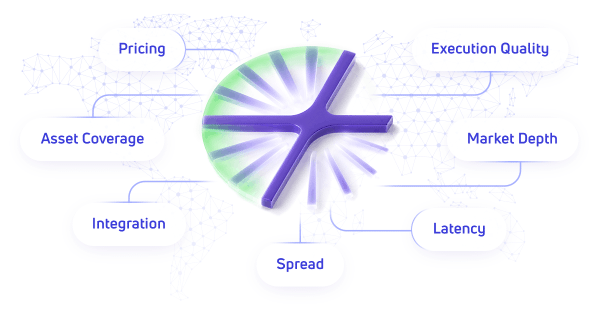
What Is a Liquidity Provider for Brokers?
A liquidity provider gives brokers access to executable market pricing and liquidity across financial instruments. Depending on its model, the provider may source pricing from banks, non-bank market makers, electronic trading venues and other institutional counterparties.
For a brokerage, the liquidity provider becomes a critical part of the execution chain between client orders and the underlying market.
The quality of this connection affects several important trading metrics:
- Bid/Ask spreads
- Available market depth
- Execution speed
- Slippage
- Fill quality
- Rejected orders
- Pricing stability during volatile markets
For this reason, choosing a liquidity provider should be treated as an infrastructure decision rather than simply a comparison of price feeds.
1. Evaluate the Sources Behind the Liquidity
The first question to ask a potential liquidity provider is where its liquidity comes from.
A single liquidity source may provide competitive pricing under normal market conditions but become less consistent when volatility increases or available market depth declines. Aggregating several institutional sources can create a more resilient liquidity pool.
A multi-source model consolidates pricing from different market participants and allows the execution infrastructure to select competitive prices from the available liquidity.
Brokers should therefore understand:
- How many types of liquidity sources contribute to the pool
- Whether institutional market makers and electronic venues are included
- How prices from different sources are aggregated
- How the provider handles changes in available liquidity during volatile periods
The number of connected sources alone does not determine liquidity quality. What matters is the resulting depth, pricing and execution available to the broker.
Luramic has already consolidated pricing from multiple liquidity sources into a unified institutional liquidity pool, providing brokers with a ready-to-use pricing and execution environment through a single connection.
2. Look Beyond the Advertised Spread
A tight quoted spread does not automatically mean better execution. The actual cost of executing an order can also depend on market depth, slippage, commissions and the amount of liquidity available at each price level. A provider showing a very narrow top-of-book spread may offer limited volume at that price.
This becomes particularly important for larger orders. For example, if only a small amount of liquidity is available at the best ask, the remainder of a large market order may execute against several additional price levels. The resulting average execution price can therefore differ significantly from the price initially displayed.
When comparing providers, brokers should examine effective execution costs rather than spreads in isolation. Useful metrics include:
- Average spread
- Spread distribution
- Average positive and negative slippage
- Market depth
- Fill ratio
- Rejection rate
- Execution price for larger order sizes
These metrics should also be tested during different market conditions rather than only during periods of normal liquidity.
3. Measure Execution Quality Under Real Market Conditions
Execution quality describes what happens between sending an order and receiving the final execution.
A liquidity provider should be evaluated using real execution data wherever possible. Testing should cover normal trading hours as well as periods when liquidity conditions become more challenging:
- Major economic announcements
- Market openings and closings
- Periods of rapidly changing prices
- Low-liquidity trading sessions
- Larger-than-average order sizes
A provider that performs well during normal conditions but experiences significant spread widening, slippage or rejection rates during volatile periods can create inconsistent trading conditions for a brokerage.
For this reason, brokers should conduct controlled testing before committing significant trading volume to a new provider.
Luramic combines aggregated institutional liquidity with a dedicated execution infrastructure designed to maintain consistent order processing and execution quality across different market conditions.
4. Check Market Depth, Not Just Best Prices
Market depth shows how much executable liquidity is available beyond the best bid and ask. This is particularly important for brokerages serving professional traders, high-volume clients and strategies that generate larger orders. Deeper liquidity can reduce the price impact of larger transactions because more volume is available across multiple price levels.
When assessing market depth, brokers should compare providers using representative order sizes rather than a single standard trade. For example, execution quality can be tested at several volume levels to determine how the average execution price changes as order size increases. This provides a much clearer picture of usable liquidity than the best displayed bid and ask alone.
5. Consider Latency Across the Entire Execution Path
Latency is the time required for trading information and orders to travel between different components of the execution infrastructure.
For brokers, the relevant latency is not simply the performance of an individual server. It is the complete path between the trading platform and the liquidity provider.
Trading Server → Bridge → Aggregator → Network → Liquidity Provider
Every additional component can introduce processing time and another network hop. Infrastructure architecture therefore matters.
Providers located close to the broker’s trading infrastructure and major financial venues can reduce network travel time. Direct connections and cross-connects inside financial data centers can reduce it further by avoiding unnecessary routing through external networks.
Luramic is available to MetaTrader 5 brokers through Ultency, the native liquidity connectivity and aggregation solution for MetaTrader 5. Because Ultency is designed specifically for the MetaTrader 5 environment, communication between the trading platform and liquidity infrastructure uses a unified, optimized protocol stack, providing a more tightly integrated execution architecture than third-party connectivity solutions.
Luramic infrastructure and broker-side Ultency instances can be deployed within the same major Equinix financial data centers, including LD4 in London, NY4 in New York, TY3 in Tokyo, HK1 in Hong Kong and SG1 in Singapore. This architecture enables direct cross-connect connectivity between a broker’s Ultency instance and Luramic infrastructure, minimizing network distance and avoiding unnecessary external network routing.
6. Review the Provider’s Integration Model
Liquidity has little operational value if connecting it requires a complicated technology stack. Traditional brokerage architectures can involve separate trading platforms, bridges, aggregators and liquidity connections. Each additional system introduces configuration, monitoring and maintenance requirements.
Before selecting a provider, brokers should determine:
- Which trading platforms are supported
- Whether FIX API connectivity is available
- Whether additional bridge software is required
- Whether an external aggregator is required
- How pricing and execution are configured
- What infrastructure must be deployed and maintained
For MetaTrader 5 brokers, Luramic is available as a liquidity provider through the Ultency infrastructure integrated with MetaTrader 5. Brokers can therefore access Luramic liquidity from their existing platform environment without deploying a separate external bridge or aggregation system.
7. Assess Multi-Asset Coverage
Adding new asset classes can become operationally expensive if every market requires a separate liquidity relationship and technical integration. A multi-asset liquidity provider can simplify this by delivering several markets through the same infrastructure.
However, instrument count alone is not enough. Brokers should also examine liquidity quality within each asset class. A provider may have excellent FX liquidity but significantly weaker depth or pricing in another market.
The goal should be consistent execution quality across the instruments that actually matter to the brokerage’s clients.
Luramic provides institutional liquidity across a broad range of financial instruments, including Forex, precious and industrial metals, commodities and global equity indices through a single liquidity relationship.
8. Understand the Commercial Model
Liquidity pricing can include several components, so brokers should calculate the total cost of the relationship rather than comparing a single headline commission.
- Volume-based execution fees
- Minimum monthly fees and deposits
- Setup or integration fees
- Connectivity charges
- Platform or bridge costs
- Additional fees for specific markets or services
Volume tiers are particularly important for growing brokerages. A pricing model that is attractive at launch may become less competitive as monthly turnover increases. Thus, brokers should model expected costs at several volume levels before selecting a provider.
Luramic uses a transparent volume-based pricing model, with commissions starting from USD 7 per USD 1 million of monthly trading volume and decreasing to USD 5 as trading volumes increase. Minimum monthly fee is USD 2,000.
9. Verify Regulation and Counterparty Structure
A liquidity relationship is not purely technological. The broker is also establishing a financial and contractual relationship with another company. Before onboarding, brokers should perform appropriate counterparty due diligence, and verify:
- The legal entity providing the service
- Applicable regulatory licences
- Jurisdiction
- Contractual terms
- Deposit and withdrawal procedures
- Onboarding and KYC requirements
- Applicable execution and risk policies
Brokers should always verify regulatory information directly with the relevant regulator rather than relying exclusively on marketing materials.
10. Test Before You Scale
The final stage of selecting a liquidity provider should be practical testing. A provider that looks competitive on paper may behave differently once connected to the brokerage’s actual trading environment. Testing should measure execution across different instruments, sessions, order sizes and market conditions.
| Metric | What to Measure |
|---|---|
| Spread | Average and distribution by instrument |
| Market depth | Available volume across price levels |
| Slippage | Positive and negative slippage |
| Latency | Order transmission and execution response |
| Fill quality | Percentage and quality of completed orders |
| Rejections | Frequency and reason for rejected orders |
| Volatility performance | Execution during major market events |
| Large-order execution | Average price as order size increases |
| Stability | Pricing and connectivity over extended periods |
The objective is not necessarily to find the provider with the best result in every individual metric. Brokers should identify the provider whose overall execution profile best matches their client flow, trading model and business requirements.